


Most businesses don’t struggle with marketing itself, but with coordinating the different parts.
You might have a freelancer handling ads, someone else building the website, another editing videos, and a fourth managing emails. Each does their part well, but if they’re not talking to each other, it’s hard to know which actions brought in customers.
This guide explains what digital marketing solutions entail, what they cost at each budget level, and how to measure their performance.
What Do Digital Marketing Solutions Mean?
Digital marketing solutions cover the tools, channels, and services a business uses online to get customers. The point is they work as one system, not as separate pieces.
Complete digital marketing solutions connect every part of your online marketing strategy under one plan. They cover the whole customer journey. It gets you found, gets the click, earns trust, closes the sale, and brings the customer back.
Digital Marketing Solutions vs. Traditional Marketing
Traditional marketing still works well in some areas. Local radio suits home services, direct mail suits older audiences, and trade print suits niche industries.
The real difference is measurement and speed. Traditional marketing gives you a rough guess, and it takes weeks to get moving. Digital gives exact results and can change in hours.
| Factor | Traditional Marketing | Digital Marketing Solutions |
| Measurement | Rough estimates | Exact numbers per click and sale |
| Cost to start | High (print, TV, billboards) | Low (testable at about $20 per day) |
| Speed to launch | Weeks to months | Hours to days |
| Targeting | Broad demographics | Precise (interests, behaviors, locations, past buyers) |
| Changing course | Expensive and slow | Instant (pause a losing ad in one click) |
| Scaling | Limited by budget and space | Scales with spend |
Measurement is the biggest gap. A billboard gives you a guess. A Google Ads campaign shows exactly what you spent, how many leads came in, and how much revenue followed, so you can compare it to your profit and decide whether to scale or stop.
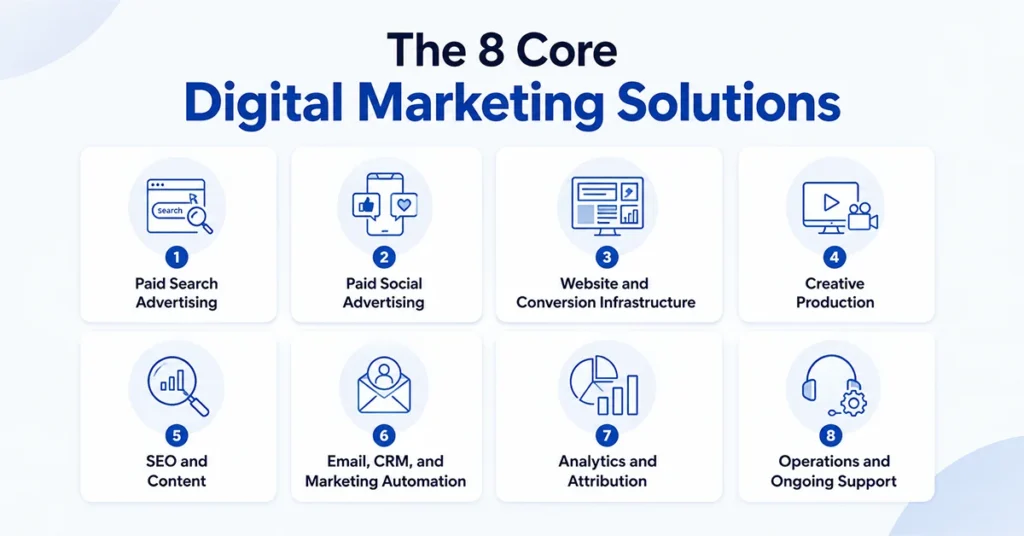
The 8 Core Digital Marketing Solutions
Not every business needs all eight right away. Here’s what each one does, how you measure it, and when it fits.
1. Paid Search Advertising
Paid search ads reach people actively searching for what you sell. Because they’re already looking, they’re far more likely to buy.
Google Ads is the main player. Microsoft Advertising offers a lower cost per click and reaches older, higher-income audiences, and it’s usually worth adding once Google Ads is already profitable.
Paid search runs on two numbers: CPA (cost per acquisition) and ROAS (return on ad spend). If your reports show impressions and clicks but no CPA, the account isn’t optimized for profit.
2. Paid Social Advertising
Search grabs existing interest, but paid social creates it.
Meta Ads use interest and behavior targeting to build audiences similar to your customers. Meta’s advertising documentation covers setup, but the real work is creative testing, not targeting settings.
TikTok Ads work best with content that feels native. A simple phone video often beats a polished studio ad. This channel is strongest with buyers under 35.
LinkedIn is the B2B pick. You can target by job title, company size, and seniority. Cost per click runs high, so it only makes sense when one customer is worth thousands.
3. Website and Conversion Infrastructure
Every other channel sends traffic here, which makes speed, mobile design, and form layout critical. Google Search Central confirms that page experience affects rankings, so this work pays off for organic traffic too.
Most businesses build on WordPress or Shopify. WordPress wins on publishing and control. Shopify wins on selling, since payment, inventory, and shipping come built in.
Conversion optimization never really stops. You test headlines, offers, form length, and button placement.
A slow or broken site just burns your traffic budget.
4. Creative Production
Meta and Google now handle targeting automatically through Advantage+ and Performance Max. Creative is the main element you still control, which makes it the most impactful part of paid media.
Graphic design covers static ads, landing pages, and product images. Video editing turns raw footage into clips for Reels, Shorts, and TikTok. 2D animation explains complex products in 30 seconds where live video needs three minutes.
The best approach is volume plus honest testing. Ten versions tested properly beat one polished asset, because you can’t predict the winner in advance. The ad you expect to lose often wins.
Budget guide: plan for creative to take up 10% to 20% of your ad spend. Underfunding it limits the effectiveness of everything else.
5. SEO and Content
SEO takes three to six months to show clear results, and once it’s working, it keeps improving without continuous ad spending.
Three elements work together. Technical SEO comes first, because if Google can’t access or understand your site, nothing else counts. On-page SEO matches your content to the terms people actually search. Content marketing takes longer: you give away useful information until people trust you enough to fill out a form.
AI Overviews and chat assistants now answer a lot of searches directly. The pages that get cited tend to share a few things: a clear answer in the first 50 words of each section, defined terms, named sources, and real numbers instead of vague claims.
Need revenue in 90 days? Run SEO and paid ads at the same time instead of picking one.
6. Email, CRM, and Marketing Automation
No algorithm decides how often you can reach customers. No bid is needed to send another email.
A CRM holds every customer contact and every interaction. HubSpot is simpler to set up, so smaller teams tend to pick it. Salesforce costs more and takes more setup, but it handles sales processes that would break a simpler system.
Segmentation just means sending different emails to different groups. Drip campaigns handle the follow-up. Someone downloads a guide, gets five emails over two weeks, and books a call on day nine. You just set it up, and it runs indefinitely.
Lead scoring puts a number on how interested someone is. Opening an email earns a few points, sitting on the pricing page earns more, and requesting a demo scores high. Sales then works the top of the list instead of calling people in signup order.
7. Analytics and Attribution
Attribution modeling decides how credit for a sale gets shared. Someone sees your TikTok ad Monday, searches your brand the next week, then buys after an email. Three touchpoints, one sale. Attribution splits the credit, and people disagree on the right way to do it.
Privacy changes have made this harder. Third-party cookies are being phased out, so accurate tracking now relies on server-side tracking and first-party data, meaning information customers give you directly.
Attribution will never be 100% accurate. Aim for directionally correct, then verify with incrementality testing. Turn one channel off for two weeks and measure the impact on total revenue. That test beats any dashboard.
Google Analytics 4 is where most of this gets tracked. Worth building out once monthly ad spend passes about $2,000. Below that, track leads in a spreadsheet and put the time into creative.
8. Operations and Ongoing Support
Strategy usually fails on execution, not planning. Content needs scheduling, comments need replies, CRM data needs updating, and ad performance needs a weekly review.
A general virtual assistant handles these daily tasks. Zapier and n8n automate repetitive tasks, connecting forms, emails, spreadsheets, and CRMs so data moves without manual copying.
Worth it when you’re spending more than five hours a week on admin that doesn’t need your judgment.
Custom Digital Marketing Solutions: Who It’s For
Two businesses with the same revenue can need completely different strategies.
Local service businesses like dentists, plumbers, and law firms depend on local search and Google Ads. Customers need help now and pick from the top results. Social media rarely justifies the cost.
E-commerce brands need the reverse: strong product images, paid social, and a fast Shopify store. Most barely profit on the first order. The real money arrives on the second and third, which is why retargeting matters so much here.
B2B software companies face long decision cycles before a sale. That means content marketing, LinkedIn, and a CRM with lead tracking. TikTok ads would waste the budget here.
Startups should run one channel until it’s proven. Split a small budget across five, and none collect enough data to improve, so all five stay unprofitable.
Custom digital marketing solutions start with three questions. Where is your revenue coming from? Where do you lose the most cash? What can your team realistically do? A company that hands you a generic package instead of answering those isn’t customizing anything.
Digital Marketing Solutions for Businesses at Every Budget
The amount you spend is more important than your industry when choosing the right marketing strategy. A law firm and an online store both spending $4,000 a month have more in common than two e-commerce brands spending $4,000 and $40,000.
Start by matching your strategy to how much you’re spending and then tweak it based on your specific industry.
Under $5,000 per month
Focus on one marketing channel. If your audience is already searching for what you sell, use paid search. Otherwise, go with paid social.
Fix your website first. Get it converting visitors before you send more traffic. Skip the complicated tracking tools; GA4’s basic features are enough, or just track leads by hand. Put the rest of the budget into testing ads, not into juggling multiple channels at once.
$5,000 to $25,000 per month
Add a second channel here. Test several ad variations each month instead of just one. Get email automation and proper conversion tracking in place. Lead generation should run as a repeatable process, not a one-off campaign.
$25,000 per month and above
A 12% lift in conversion rate can add $40,000 a year in revenue. At this level, that’s worth the cost of tracking attribution, testing tactics, watching customer behavior over time, and keeping a team on creative.
Keep comparing customer acquisition cost to lifetime value. Do it continuously, not once a quarter.
How to Choose a Digital Marketing Solutions Company
Every agency site claims results. The hard part is working out which claims mean anything.
Case studies from your kind of business. A digital marketing solutions company might have ten strong e-commerce wins and no B2B lead generation experience at all. Different job, different skills. Ask what they’ve produced for companies that make money the way yours does.
Reports that open with profit. If page one shows impressions, reach, and engagement rate, you’re reading activity. CPA, ROAS, and cost per lead should be near the top.
One team on the account. Ads, creative, web, and tracking work better in one room. Spread them across four vendors and a bad month turns into three weeks of everyone blaming everyone else while the budget keeps running.
Ownership in writing. The Google Ads account. The Meta Pixel. The site, the analytics. Plenty of agencies keep these under their own name, and it’s rarely by accident.
A willingness to say no. Ask which of these eight solutions you should skip. A good digital solutions marketing company will name one without hesitating. Anyone who answers “none of them” is selling rather than advising.
Run that same list against TrackPad. Ads, web, creative, and automation sit with one team, so there’s no second vendor to blame when numbers dip. Reports lead with ROAS and cost per lead. Every account stays in your name from day one. That model has run across 150+ brands and $480M in client revenue.
How to Measure Success
Many marketing reports are built to look good, not to help you decide anything. Reach, impressions, and engagement usually climb when you spend more, but that doesn’t mean the money worked.
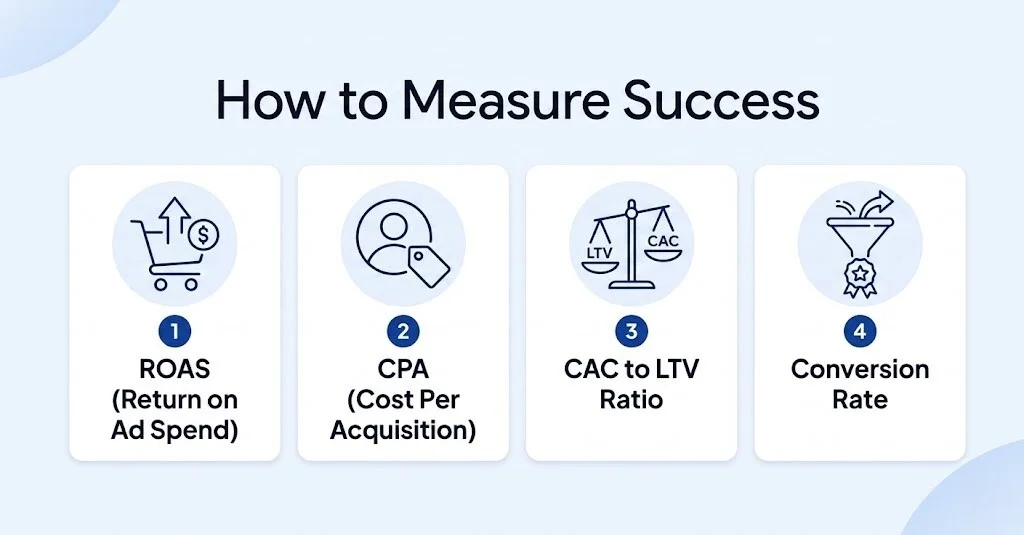
Four key numbers really count. Each helps in its own way, but each also has some blind spots.
ROAS (Return on Ad Spend) is revenue divided by ad spend. Spend $1,000, make $4,000; that’s a 4X return. But ROAS says nothing about what it costs you to make or deliver the product. A 4X return can still lose money if your margins are thin.
CPA (Cost Per Acquisition) is what it costs to land one customer. Spend $2,000, get 25 customers; that’s $80 each. Check that against what each customer is worth to you. If $80 buys a customer who only brings in $60, you’re losing money on every sale.
CAC to LTV gets ignored a lot, but it matters for growth. CAC is what you spend to get a customer. LTV is what that customer spends with you over time. A healthy ratio sits around 1:3. That’s why a 2X ROAS can work fine if customers keep coming back, while a 6X ROAS can still be weak if they don’t.
Conversion rate simply shows how many visitors take the desired action. Improving this rate can boost all your marketing channels at once, which is why fixing your site is usually cheaper than buying more traffic.
Tracking these four numbers accurately means you don’t need to read the other forty reports.
Frequently Asked Questions
What are digital marketing solutions in simple terms?
These are the online tools and services a business uses to find and keep customers, including ads, websites, content, email, and tracking, all working together as one system.
How much do digital marketing solutions cost?
Small businesses in the U.S. typically spend between $2,000 and $7,000 a month, including the ad budget. Mid-sized companies spend between $10,000 and $40,000 a month.
How long before I see results?
With paid ads, leads can start coming in within days. Email automation works within weeks. Organic search needs three to six months before the traffic builds.
Do I need all eight solutions at once?
No. Start by fixing your website’s conversion rate and proving one traffic channel, then expand from there.
What’s the difference between a digital marketing agency and a solutions company?
An agency handles one thing: ads or SEO. A solutions company covers strategy, creative, ads, web, and automation, all under one roof.
Can small businesses compete with big brands online?
Yes. Small businesses move faster and can target tighter groups than big brands. The advantage comes from focus, not budget size.
The Bottom Line
Businesses that see real digital business growth aren’t necessarily the ones using the most marketing channels. They are the ones where the ads, landing pages, and offers all match up, and every dollar spent leads to a result.
Fix your website. Prove one channel works. Measure those five numbers honestly. Only add more complexity once the simple version is working.
Book a free 30-minute strategy call. We’ll review your ads, funnel, and workflows, and you’ll leave with a plan, whether or not you work with us.