B2B digital marketing is harder now. Buyers use search, LinkedIn, email, and AI tools before they contact sales. The buying journey often spans several months, which gives you time to earn trust. Steady work and the right metrics reveal the full picture. This guide shows which channels work and how to connect them into one plan.
What does B2B digital marketing cover?
In business-to-business (B2B) marketing, your customer is another company. You might sell software, equipment, or a service. Business-to-consumer (B2C) marketing sells to individual shoppers instead. The digital part means the work happens online: search results, LinkedIn feeds, inboxes, webinars, review sites, and AI answer engines.
The hard part is the audience. You are persuading a group, and groups move slowly.
Each person asks a different question. A CFO wants the payback period. An IT lead wants SOC 2 reports and API docs. Good digital marketing for B2B business gives each person the answer they need, on the channel they already use.
B2B vs B2C:
A consumer brand can win a sale in one scroll. Someone sees a hoodie on Instagram, taps, pays. B2B purchases get more thought, because the right vendor can lift a whole team’s results.
This table shows where B2B and B2C marketing go separate ways:
| B2B | B2C | |
| Who buys | Buying groups of roughly 10 to 13 people, including executives, IT, finance, and end users | One person or a household |
| Sales cycle | Months, often close to a year | Minutes to days |
| What drives the decision | ROI, risk reduction, operational fit and trust | Emotion, price, convenience and identity |
| How buyers research | Self-guided research, peer reviews, analyst reports and AI tools | Social feeds and quick comparisons |
| Content that works | Case studies, guides, webinars, demos, ROI calculators | Short video and promotions |
| Metric that matters | Pipeline and revenue per account | Conversion rate and order value |
The Best B2B marketing channels
You need the right mix for where your buyers spend time. We narrowed the field to seven B2B digital marketing approaches worth your budget. Each one fits a different stage of the sale.
Here is how the channels map to each stage of the buyer journey:
- Awareness: SEO content, AEO, and LinkedIn reach buyers while they define the problem.
- Consideration: Case studies, webinars, email nurturing, and retargeting keep you on the shortlist.
- Decision: Google Ads, demos, account-based outreach, and fast sales follow-up close the deal.
1. Content and SEO that answer buyer questions
Buyers research alone. That makes content marketing the engine of B2B demand generation, and search engine optimization is how buyers find that content. Publish what buyers search for while they define the problem: how-to guides, comparison pages, pricing explainers, whitepapers, eBooks, technical docs, and case studies with real numbers.
Two things separate content that builds pipeline from content that fills a blog:
- It answers commercial questions. Pages like “how much does X cost” or “X vs Y” attract people close to a decision.
- It shows proof. Named results, screenshots, timelines, and reviews on site.
The technical basics still decide who ranks. Target the keywords your buyers type, write clear metadata and image alt text, and earn links from industry sites and partners.
If you want to see how SEO fits with paid media and creative, our digital marketing solutions guide maps the whole picture.
2. Answer engine optimization (AEO)
Buyers now ask ChatGPT, Gemini, Perplexity, and Google’s AI Overviews to suggest vendors. AEO means shaping your content so those tools find it and cite it.
Google’s advice is simple. Its guide to generative AI features in Search says standard SEO still applies and that unique, useful content matters more than any trick. In practice, that means:
- Answer the main question in the first 100 words
- Write H2s that sound like real buyer questions
- Keep pages crawlable and fast, with links from related pages
- Publish original data and real examples a summary cannot copy
3. LinkedIn and LinkedIn Ads
In B2B social media marketing, LinkedIn is where buyers pay professional attention. 2026 surveys rank it the top channel for thought leadership, named by 76% of B2B marketers.
LinkedIn Ads let you target by job title, seniority, company size, and industry. That maps onto a buying group. Clicks cost more here, and the returns make it worth it. Dreamdata’s 2026 LinkedIn benchmarks found it was the only major ad platform with a positive ROAS for B2B advertisers across the full sales cycle.
Do not skip organic. Posts from founders and experts usually beat company page posts. People trust a named person explaining a real problem more than a logo announcing a feature. Pick two or three experts. Block an hour a week for posting.
4. Paid search with Google Ads
Search ads catch buyers the moment they type a problem into Google, like “inventory software for distributors” or “SOC 2 compliance tool.” That intent is hard to buy anywhere else.
The secret to B2B search ads is precision. Broad keywords pull in students, job seekers, and competitors checking your pricing. Tight keyword lists, negative keywords, CRM conversion imports, and landing pages built for one audience fix most of it. Our Google Ads management team connects GA4 and Google Tag Manager before a single dollar goes live, so you see which clicks become qualified pipeline.
5. Meta and TikTok for B2B retargeting
Most B2B teams ignore these platforms. Recent surveys show only about 20% of B2B marketers use TikTok. We see that as an opening. Your buyers scroll Instagram and TikTok after work like everyone else, and fewer B2B advertisers compete for their attention.
These platforms work best for retargeting site visitors and promoting webinars, especially when your buyers are founders of smaller companies. Short, clear video does most of the work. Track-Pad runs Meta Ads campaigns and TikTok Ads for brands that want more reach per dollar.
6. Email nurturing and marketing automation
A long sales cycle means email keeps you present between buying moments. Platforms like HubSpot, Marketo, and Salesforce Marketing Cloud send messages based on what a contact does, not on a fixed calendar.
Say someone visits your pricing page three times in a week. Automation can alert the account owner and send a case study from their industry. That beats another monthly newsletter.
Keep segments tight, write clear subject lines, and use one call to action (CTA) per email. Check every email on mobile. Score leads on fit (company size and industry) and on behavior (pricing page visits and webinar attendance).
7. Account-based marketing (ABM)
Account-based marketing flips the funnel. Instead of attracting many leads and filtering later, you pick a short list of high-value accounts and market to the whole buying group inside each one.
Good data makes this practical for mid-market teams. ZoomInfo gives firmographic and contact data, so you know who works where. 6sense tracks intent signals, like which companies research your category this month. Your CRM pulls it together so sales sees every touch.
In practice, ABM means personalized landing pages, LinkedIn Ads aimed at named accounts, direct mail to the economic buyer, and sales outreach timed to intent spikes. Start with 25 to 50 accounts. Add more once the first batch shows results.
How to build a B2B digital marketing strategy in 6 steps
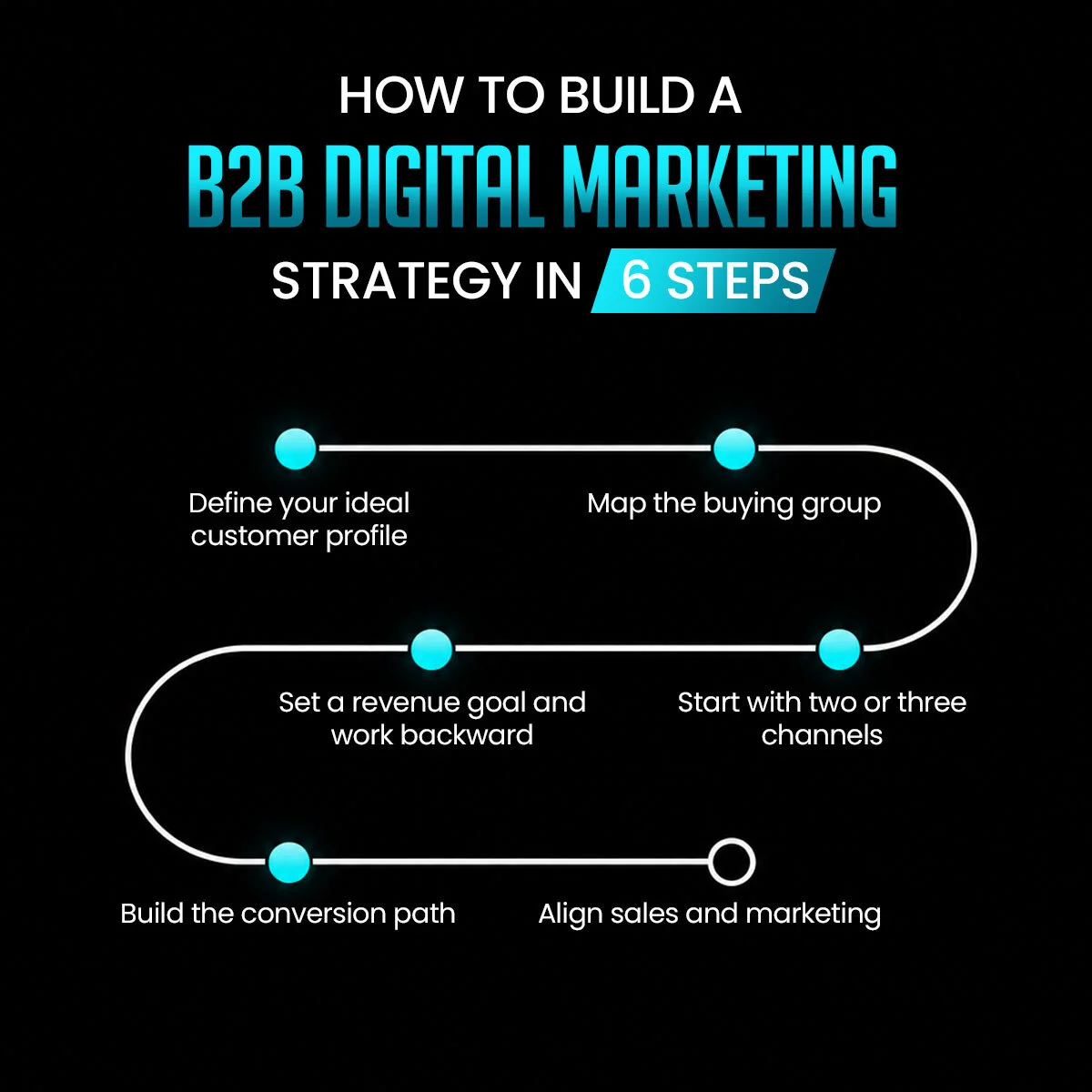
Here is the order we would follow to build a plan from scratch, or to fix one that stalled.
- Define your ideal customer profile. Write down the industries, company sizes, revenue bands, and tech stacks of your best customers. Aim every campaign at companies that match this target audience. Your top 20 accounts by lifetime value are the best starting data, and tools like ZoomInfo can fill the gaps.
- Map the buying group. List every role in a typical deal and build a simple buyer persona for each, with the question that person needs answered. Interview recent customers and ask what almost stopped them from buying.
- Set a revenue goal and work backward. Pick a pipeline target, then work out how many qualified opportunities it takes to hit it. That math sets your budget and tells you which channels come first.
- Start with two or three channels. Many B2B companies start with SEO content plus one paid channel, usually LinkedIn or Google Ads, then add retargeting and account-based work once leads flow. A focused budget gives each channel enough spend to show real results.
- Build the conversion path. Every channel needs a destination: a fast landing page, a short demo form, a calendar link, or a case study. A strong page turns good traffic into real leads.
- Align sales and marketing. Agree on what counts as a marketing-qualified lead, set a follow-up deadline, and review closed-lost deals together every month.
If your plan touches systems and processes as well as campaigns, our guide to digital transformation solutions covers the operational side.
What changes by industry
The channels stay similar across sectors. The content inside them changes a lot.
SaaS and technology: Free trials and comparison pages carry real weight. Product-led companies should count product sign-ups as a pipeline source, alongside form fills.
Manufacturing and industrial: Buyers want specs, CAD files, certifications, and lead times. Clean product catalogs and technical content matter more than clever ads. Many manufacturers also run online portals for reorders, and our piece on digital commerce solutions explains how those fit in.
Professional services and consulting: Trust is the product. Expert articles, webinars, client results, and active LinkedIn profiles from partners drive most of the pipeline.
How to measure ROI over a long sales cycle
The most common B2B measurement mistake is judging campaigns too early. If you only check results after 30 days, you miss most of the story. B2B buyers often take most of a year to decide. A LinkedIn campaign can look costly in week three and still bring your best leads by month seven.
Track these numbers instead of clicks and likes:
- Pipeline generated and influenced, by channel and by campaign
- Your customer acquisition cost (CAC), meaning what you spend to win each new client, and how soon that money comes back
- MQL to SQL conversion rate, which shows whether sales agrees with marketing on lead quality
- Win rate and deal velocity, meaning how fast opportunities move between stages
- Engagement across your target account list
- How much each account spends with you over time, counting upsells and renewals
Connect your ad platforms and website analytics to your CRM so every closed deal traces back to its first touch. Salesforce and HubSpot both offer multi-touch attribution reporting, but those reports are only as good as the tracking behind them. Clean UTM tags and offline conversion imports make the difference.
The benchmarks in this guide are a starting point, and most come from tech companies. Six months of your own clean data will tell you more than any industry average.
Frequently asked questions
What is the main goal of B2B digital marketing?
To build a predictable pipeline by earning trust with buying groups before they contact sales, then supporting those deals to revenue.
How many months does a B2B deal usually take to close?
It depends on deal size and industry. Recent research puts the full buying process at roughly 9 to 10 months.
Which B2B marketing channels work best?
For most mid-market companies, start with SEO content, LinkedIn, Google Ads, and email nurturing. Add ABM and retargeting once your target accounts are clear.
How is digital marketing for B2B business different from B2C?
B2B sells to groups making high-risk decisions over months. B2C sells to individuals who decide fast, often on emotion and price.
Is content marketing still worth it with AI search?
It matters more now. AI tools build answers from published pages, so original, specific content feeds both search rankings and AI answers.
Run B2B digital marketing under one roof with Track-Pad
Most stalled growth comes from too many vendors. One agency runs ads. A freelancer builds the site. Another team makes videos. No one owns the pipeline number. Track-Pad puts paid media, creative, web development, and operations in one team with one strategy.
Here is what you can run with us:
- Paid campaigns on Google, Meta, and TikTok, run by one team
- Creative work: graphic design, video editing and 2D animation
- Web development for fast, conversion-focused sites
- Virtual assistants for CRM updates and campaign reporting
We have worked with 150+ brands and managed over $40M in ad spend. If your B2B digital marketing creates activity but little pipeline, audit your top three channels and your conversion path this quarter. Talk to Track-Pad, and we will show you where the leaks are.