Most companies already own the software. The CRM is paid for, the cloud storage runs fine, and someone signed off on project management seats last spring. None of it talks to each other, so staff still retype the same order details into three systems.
Digital transformation solutions close that gap. This guide covers what they include, which pay back first, and how to keep a rollout from stalling.
What Are Digital Transformation Solutions?
Digital transformation solutions are the technologies and processes a business uses to replace manual work, connect scattered data, and serve customers through digital channels. What separates them from ordinary software is that the pieces connect.
A digital solution earns the word transformation once it changes how the work happens. Scanning a paper form to PDF changes nothing, since somebody still keys it in by hand. Make it an online submission that routes itself, updates the CRM, and books the follow-up, and the work has moved.
Common mistake to avoid: Buying software before mapping the process. A broken workflow fails faster once it runs on autopilot.
The Benefits of Digital Transformation
Vague promises attach to the benefits of digital transformation more than to most business topics. Here is where the gains actually land, and the number that proves each one.
| Benefit | What changes | How you measure it |
| Workflow automation | Manual entry, paper approvals, and spreadsheet handoffs disappear | Hours saved per week, error rate per 100 records |
| Customer experience | Buyers self-serve: order status, quotes, booking, support | First response time, repeat purchase rate |
| Data-driven decisions | Scattered records merge into one source of truth | Time to pull a report, forecast accuracy |
| Scalability | Cloud technology replaces server purchases | Cost per new user, location, or order |
| Operational efficiency | Shared platforms cut duplicate work between teams | Output per employee, project cycle time |
Two of these pay back faster than the rest.
Workflow optimization shows up in payroll within weeks, because hours are countable. Customer experience shows up in revenue, but you need a full sales cycle before the reading means anything. Data-driven decisions depend on where records live. A HubSpot pipeline reads differently than a Salesforce one, so the report has to match the system. Scalability takes the longest to prove and gets oversold hardest. It earns its budget when you open a location or triple order volume.
Skip it if: Your team is under ten people and everybody already works off the same spreadsheet. Fix your website and your lead flow first.
The Six Types of Digital Transformation Solutions
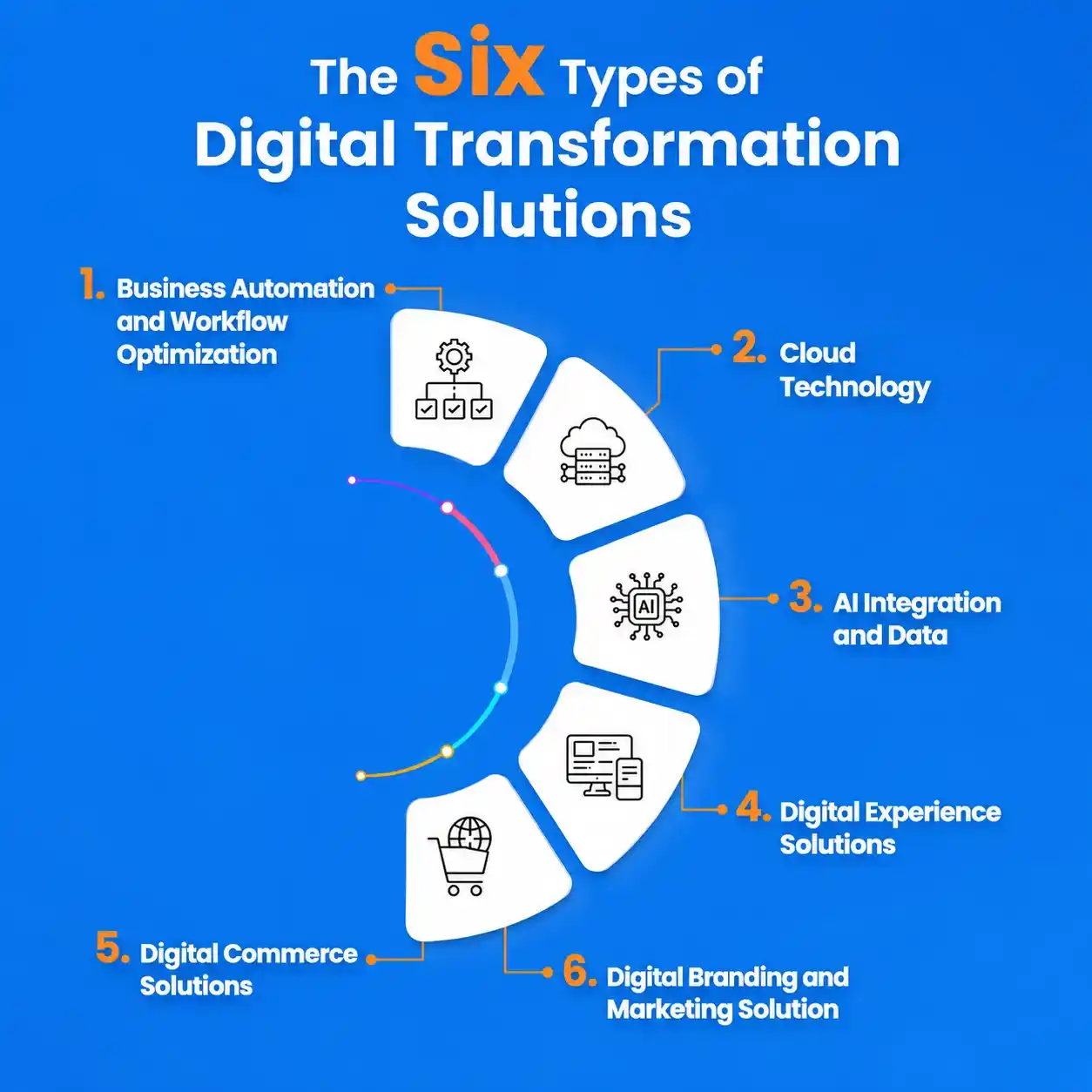
Every vendor sells one slice of this and calls it the whole thing. These six cover the full picture. Most businesses need three or four.
1. Business Automation and Workflow Optimization
This is the internal plumbing. Forms, approvals, data syncing, and reports nobody should assemble by hand. Teams coordinate in Slack or Monday.com, then wire their apps together so a record gets entered once.
Somebody still owns the exceptions. A virtual assistant catches what the rules miss, which is why automated systems keep working after month two.
2. Cloud Technology
Cloud technology takes the hardware bill out of growth. AWS, Microsoft Azure, and Google Cloud all do this competently, and your existing stack usually decides the answer. Migrating for one feature you touch twice a year rarely earns back the move.
3. AI Integration and Data
Salesforce, SAP, Oracle, and HubSpot hold the records. AI integration reads them and flags what a dashboard scan would miss. Which leads convert. Which orders slip. Which accounts go quiet weeks before they cancel.
Common mistake: Running AI on messy records. Clean them first, or you get answers that sound authoritative and are wrong.
4. Digital Experience Solutions
Digital experience solutions cover what a customer touches. Page speed, mobile layout, form length, and how many clicks stand between a question and its answer.
This is the half of transformation buyers can see. Nobody notices your operational efficiency gains. Everybody notices a checkout that takes four seconds to load. Web development spending here tends to return more than another platform license. 2D animation earns its place when a product needs demonstrating instead of describing.
5. Digital Commerce Solutions
Digital commerce solutions tie the storefront to inventory, payments, and shipping, so shoppers see real stock counts and honest delivery dates. When they drift out of sync, you get abandoned carts that look like a pricing problem. Usually it is a trust problem.
Google’s page experience guidance confirms speed and stability feed rankings, so this work pays twice.
6. Digital Branding and Marketing Solutions
Digital branding solutions carry the message once the systems change. Capability nobody hears about generates nothing.
New positioning needs new assets: graphic design for refreshed ad creative and product imagery, video editing for short cuts wherever your audience watches. Enterprise digital marketing solutions handle distribution.
- Google Ads catches people already searching.
- Meta Ads builds demand among audiences that resemble your buyers.
- TikTok Ads reaches younger viewers who respond to video that does not look like advertising.
Digital marketing solutions cover the paid, organic, and creative channels above, plus how they’re supposed to work together instead of competing for the same budget. Our guide to digital marketing solutions breaks down what each channel costs and how to measure it.
Building a Digital Transformation Strategy for Business
A digital transformation strategy for business works as a sequence. Treat these five steps as your framework.
- Name the cost you want to remove. “Improve efficiency” commits you to nothing. “Our team spends 14 hours a week retyping order data” gives you a target and a baseline.
- Map the process before you buy. Write out every step and handoff, including what already runs through SAP or Oracle. Roughly half the fixes turn out to need no new software.
- Pick one workflow and finish it. Three half-finished rollouts create more work than they remove, since people maintain both systems.
- Set the measurement first. Record hours, error rates, or response times while the old process still runs. A gain you never baselined, you cannot prove.
- Train before launch. Adoption kills more projects than technology does. Post the schedule in Slack and budget real hours for it, not a fifteen-minute walkthrough.
Skip it if: No named decision-maker owns the project. Transformation by committee stalls at the first budget disagreement.
Why Most Transformation Projects Stall
The failure rate is real, worth knowing before you sign anything. McKinsey’s global survey found that only 16% of respondents said their organization improved performance and held onto the gain over time.
Three causes explain most of it:
- Nobody owns it. Blockers sit untouched until someone escalates.
- Too many fronts at once. Five simultaneous rollouts split attention until none finish.
- Copied stacks. A competitor’s tools were bought to fix a competitor’s problem.
How to Choose a Digital Transformation Solutions Company
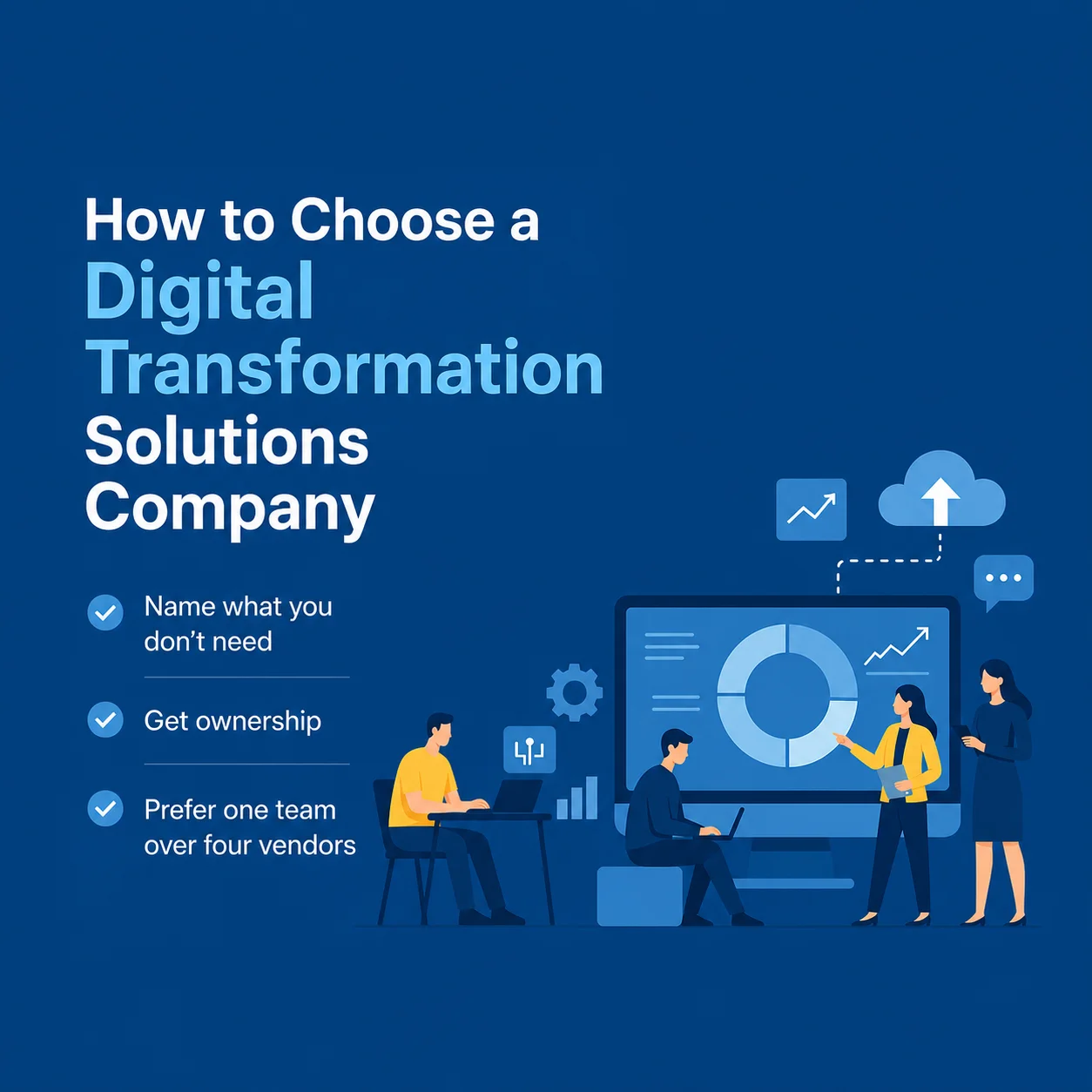
Most U.S. providers handle either the internal systems or the customer-facing work, rarely both well. Establish which half you are buying before anything gets signed.
- Name what you don’t need. A provider who claims you need all six has not looked at your business.
- Get ownership. Your AWS or Azure account, your ad accounts, and the site itself should be registered to your company before work starts.
- Prefer one team over four vendors. When systems and marketing sit with separate firms, a bad quarter produces finger-pointing.
TrackPad keeps ads, web, creative, and automation under one team. That covers 150+ brands and $480M in tracked client revenue.
Frequently Asked Questions
How is digitization different from digital transformation?
Digitization converts records into digital format. Transformation changes the process: who does the work, what the customer experiences.
How long does digital transformation take?
One workflow takes four to twelve weeks. A department-wide rollout runs 12 to 24 months, depending on how many systems connect.
What does digital transformation cost for a small business?
Most U.S. small businesses spend $2,000 to $10,000 monthly across software, integration, and the marketing that promotes it.
Is digital transformation the same as digital marketing?
No. Transformation rebuilds internal systems and customer experience. Marketing drives demand toward them. A business usually needs the systems working before the marketing spend pays off.
Which department should go first?
Whichever loses the most hours to manual work. Begin where time savings are easiest to count.
Does AI replace the need for transformation?
No. AI reads your data. When that data sits in disconnected systems, AI inherits every gap your team works around.
The Bottom Line
Digital transformation solutions work when they are sequenced. Find the workflow bleeding the most hours, map it, fix it, measure it, then move on. The internal side saves money. The customer-facing half converts that saving into revenue: your site, your creative, your ads.
Grab a free 30-minute call. We will look at your site, ad accounts, and workflows. You walk away with a sequenced plan you can run yourself.