
Digital commerce solutions are the connected platforms and tools a business uses to sell online across every channel it touches. Not one website. Not one checkout. A single system of record sitting behind the storefront, the marketplace listing, the social shop, and the counter in the store. Get that architecture right and growth compounds. Get it wrong, and it stalls at the first bottleneck. Below are the seven layers, in the order you should fix them.
What Are Digital Commerce Solutions?
Digital commerce solutions are connected software platforms that let a business sell goods, services, and digital products across every channel: your online store, marketplaces, social storefronts, mobile apps, and in-store pickup.
They cover more ground than ecommerce alone. Ecommerce is the transaction: cart, payment, confirmation. Digital commerce covers the whole customer journey, from the first ad someone scrolls past to the reorder a year later.
The same seven layers serve B2C brands, B2B wholesalers, and hybrid sellers. What changes is checkout: B2B needs tiered pricing, order minimums, and approval steps B2C never touches.
The U.S. Census Bureau put e-commerce at 17.1% of U.S. retail spending in 2026’s second quarter. Brick-and-mortar grew that quarter too. Online just grew close to twice as fast.
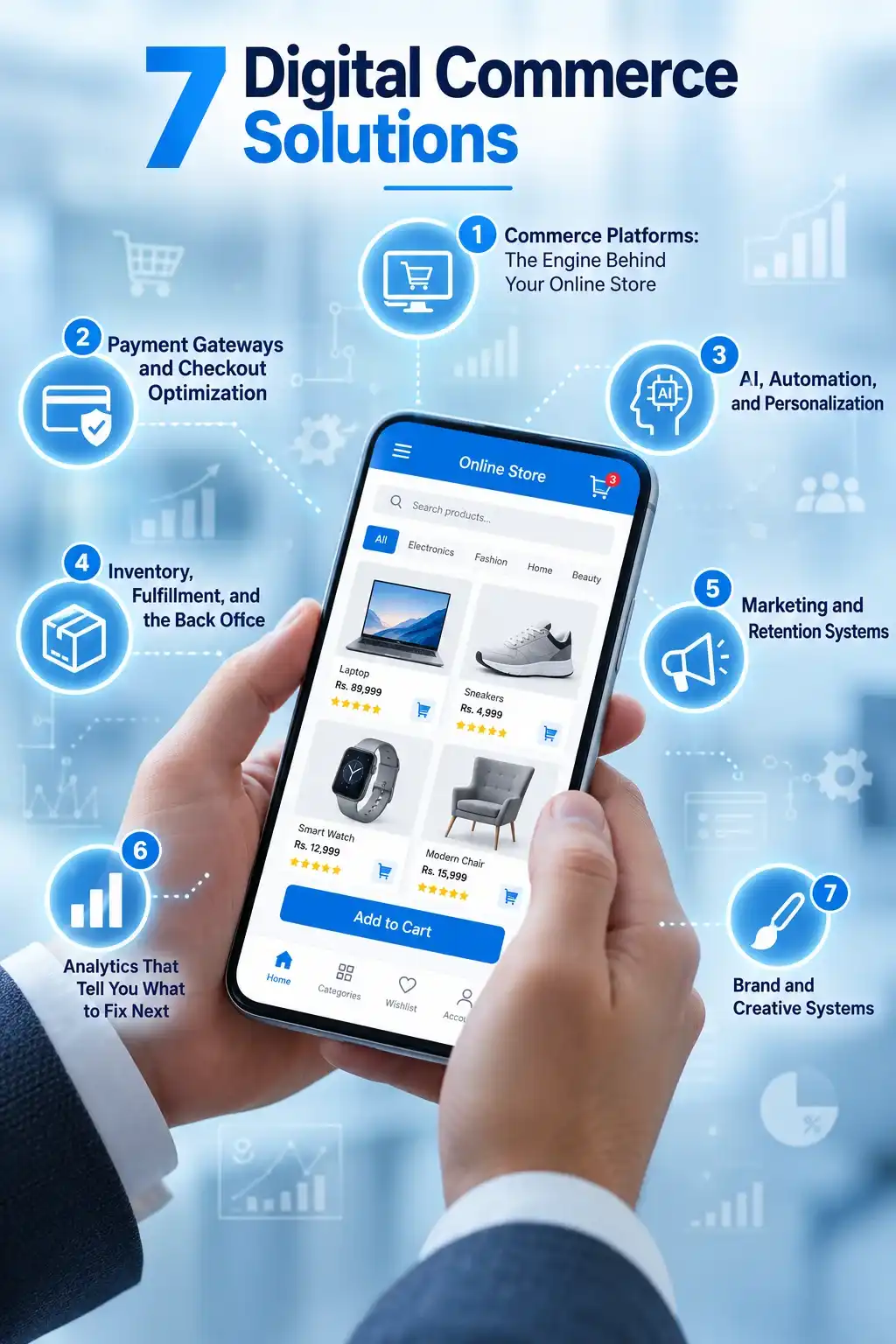
1. Commerce Platforms: The Engine Behind Your Online Store
Your ecommerce platform holds the catalog, prices, product pages, cart, and checkout. Everything plugs into it, so this pick sets the ceiling for your stack.
Shopify wins on launch speed and app choice, which fits most small and mid-sized B2C sellers. BigCommerce handles big catalogs, B2B pricing rules, and headless builds without dozens of plugins. WooCommerce suits brands already on WordPress that publish heavy content.
Match it to catalog size, your team’s tech skills, and how much of the front end you want to control. A stock theme gets you live fast, but a store built around how your customers shop converts better every month. That is where custom web development earns its cost back, and it is the first thing our build team fixes.
2. Payment Gateways and Checkout Optimization
A payment gateway moves money from the buyer’s card into your account and carries the fraud and compliance load. Stripe handles subscriptions, marketplaces, and global currencies. PayPal brings a button U.S. shoppers already trust, and offering both usually beats picking one.
Checkout is the biggest leak in most stores. About 70% of carts get abandoned, and better checkout design alone can lift conversion rate by roughly 35%, based on Baymard Institute research across dozens of studies.
Checkout optimization is boring work that pays fast:
- Show shipping, tax, and fees before the cart page. Surprise costs are the top fixable reason people quit.
- Turn on guest checkout. Forced sign-ups kill finished sales.
- Cut form fields to the minimum, allow autofill, and add digital wallets and buy now, pay later options.
- Keep card data inside a PCI DSS-compliant flow and show your processor logo near the pay button.
3. AI, Automation, and Personalization
If a shopper cannot find the product, no ad budget saves that visit. Site search and recommendation engines decide what each person sees, and Amazon-trained buyers expect results that read intent instantly.
These tools cover smart product search, tailored recommendations, and dynamic pricing. Start with the free wins: pull your zero-result search report monthly and add synonyms for the words customers actually type.
Automation sits in the same layer. AI now drafts product descriptions, sorts support tickets, and forecasts demand before you reorder. This is the core of digital experience solutions: the store adapts to the shopper instead of one fixed path.
4. Inventory, Fulfillment, and the Back Office
Sell the same item in three places and eventually you sell the same unit twice. Operations tools exist to stop that. They push stock counts between channels in real time, so your Shopify storefront is not still advertising a size medium that shipped on an Amazon order this morning.
The pieces that matter are order routing to the closest warehouse and clean data flow into your ERP or CRM. Returns count too: a slow refund hurts repeat purchase rates more than slow shipping.
Most of this still needs human hands for exceptions, listing updates, and supplier follow-ups. A trained virtual assistant clears that queue every morning for a fraction of an in-house hire, which is why ecommerce digital solutions rarely work as software alone.
5. Marketing and Retention Systems
Traffic and retention sit in the same layer, and treating them as separate budgets is how ad costs spiral.
On the retention side, Klaviyo turns store data into automated email and SMS flows: browse abandonment, win-back offers, and refill reminders. These earn the most revenue per send because they fire while intent is fresh.
On the acquisition side, Meta is still the strongest platform for interest-based prospecting. Search captures people already hunting for what you sell, and short-form video builds demand before the query. This mix is where digital marketing solutions meet commerce infrastructure. Our Google Ads, Meta Ads, and TikTok Ads teams wire all three into the data your store already holds, so every dollar chases proven buyers, not guesses.
6. Analytics That Tell You What to Fix Next
You need both. Google Analytics tells you what happened: which channels drove sessions, where the funnel narrowed, what a customer is worth. Hotjar tells you why. Recordings and heatmaps show the field people rage-click and the button hidden under a sticky banner.
Track each checkout step as an event, find the worst drop-off, then watch ten recordings. That turns a vague conversion rate complaint into a fix you can ship this week, and it is the base of any digital commerce strategy worth funding.
7. Brand and Creative Systems
Two stores can sell the same product on the same ecommerce platform and get very different results. The difference is usually creative.
Creative is a performance input, not decoration. Ad platforms optimize around engagement, so the asset drives your cost per sale. Photos and thumbnails decide whether anyone stops scrolling. Demo videos answer objections a paragraph never will. Explainer animation makes a technical product clear in 30 seconds.
Consistency turns a store into a brand people recall, and strong digital branding solutions come from repeatable systems. That is what our graphic design, video editing, and 2D animation teams deliver: a fresh, on-brand asset set every week, not one photoshoot a quarter.
How the Seven Work Together
Connected, these tools produce three results you can measure.
Omnichannel reach. Your site, marketplace listings, social storefronts, and front counter share one stock count and one customer record. The buyer gets one customer journey, not four disconnected brands.
Operational efficiency. Orders route, stock updates, and receipts are sent with no one touching a spreadsheet.
Data-driven growth. Live reporting shows what to reorder, which campaign to scale, and which checkout step to rebuild next.
That connective work is what broader digital transformation solutions deliver: fewer scattered tools, one source of truth, and marketing and digital solutions that share data instead of fighting over it.
Where to Start
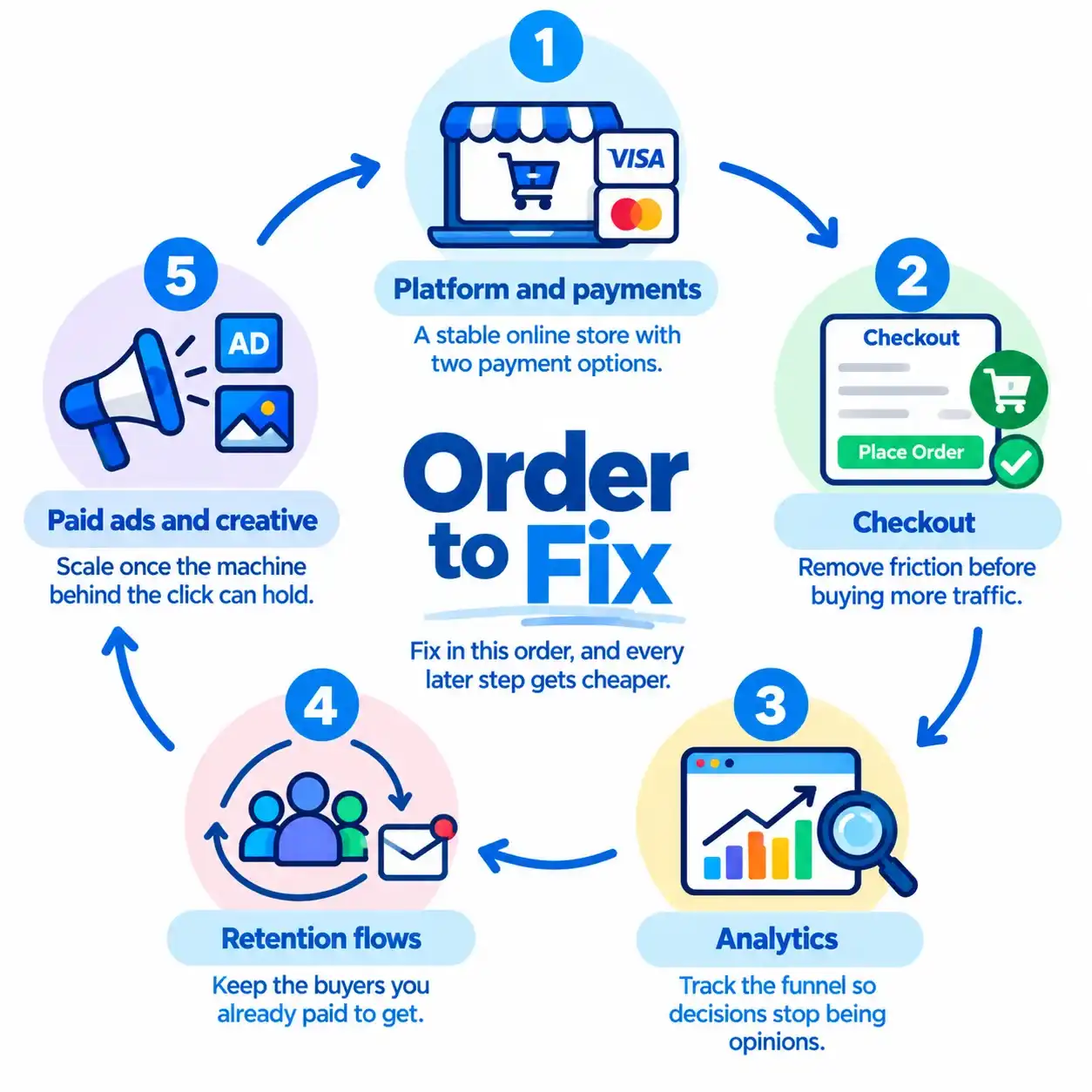
Fix in this order, and every later step gets cheaper:
- Platform and payments. A stable online store with two payment options.
- Checkout. Remove friction before buying more traffic.
- Analytics. Track the funnel so decisions stop being opinions.
- Retention flows. Keep the buyers you already paid to get.
- Paid ads and creative. Scale once the machine behind the click can hold.
Most brands buy this stack from five vendors who never speak to each other.
Track-Pad runs all seven layers with one team: store builds and web development, growth across Google Ads, Meta Ads, and TikTok Ads, conversion-first graphic design, video editing, and 2D animation, plus virtual assistants on daily order and listing work. One partner, one dataset, zero handoffs.
Frequently Asked Questions
What is different about digital commerce and e-commerce?
E-commerce is the sale itself. Digital commerce is everything wrapped around it: how buyers find you, how orders reach them, what brings them back.
What should a business budget for this stack?
Most small stores stay under $500 a month. That number climbs with catalog size, order volume, custom build work, and paid add-ons.
Where should a small store spend first?
Get the platform and payment gateway solid. Repair checkout second. Add analytics third, before any ad budget goes out.
Do I need all seven categories?
No. Add each layer when a real problem shows up: abandoned carts, stockouts, or one-time traffic that never returns.
Does this apply to B2B or only B2C?
Both. B2B sellers need the same seven layers plus account pricing, quote approvals, and purchase order support built into checkout.
Can one agency manage the whole stack?
Yes. One team across ads, site builds, creative, and support keeps data connected and prevents handoff gaps that lose sales.
The Bottom Line
The businesses pulling ahead are not running the most software. Their systems talk to each other, so a TikTok click and a reorder six months later belong to one customer.
Audit one layer at a time. Find the step where people leave and fix it. Track-Pad builds and manages every one of these digital commerce solutions under one roof. Tell us where your funnel breaks and we will show you what to fix first.